






Skip to content
View sepahead's full-sized avatar
🐳
building something great.
🐳
building something great.

Block or report sepahead

Block user

Prevent this user from interacting with your repositories and sending you notifications. Learn more about blocking users.

You must be logged in to block users.

Content in all repositories owned by your account will be closed.
Maximum 250 characters. Please don’t include any personal information such as legal names or email addresses. Markdown is supported. This note will only be visible to you.
Report abuse

Contact GitHub support about this user’s behavior. Learn more about reporting abuse.

Report abuse
sepahead/README.md

Sepehr Mahmoudian, Senior AI Engineer in Berlin building domain-specific AI agents and custom harnesses for auditable research and engineering, with work spanning LLM/VLM evaluation, computational neuroscience, robotics and multimodal 3D perception. Rust and Python; GitHub member since 2014.

Sepehr Mahmoudian on LinkedIn — Senior AI Engineer in Berlin    Sepehr Mahmoudian on Google Scholar — research publications    Sepehr Mahmoudian on Substack — @torusprime, notes and essays    Sepehr Mahmoudian on Hugging Face — @torusprime, datasets    Sepehr Mahmoudian on X (Twitter) — @SepAhead

Curriculum Vitae · English  ·  Lebenslauf · Deutsch

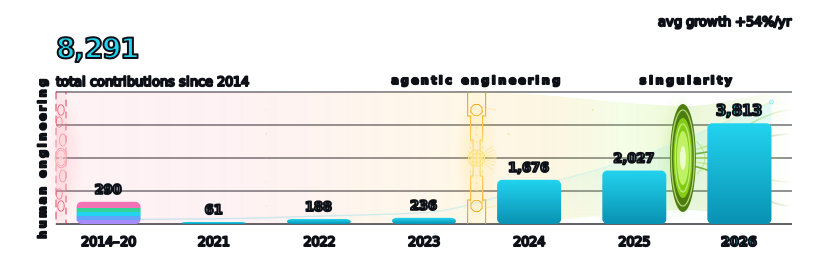
The pulse — GitHub contribution activity

Annual contributions from 2014 to present, with 2014–2022 grouped into a single history bar and a running cumulative total; the highest year so far glows, its in-progress status is explicitly qualified, the year in progress carries a dashed cap, average growth is qualified with its base year, the next year sits as an empty dashed placeholder and the following year as an unstarted future runway slot, with the visual phase motif resolving between them into 20 rays of light streaming from above into the future.

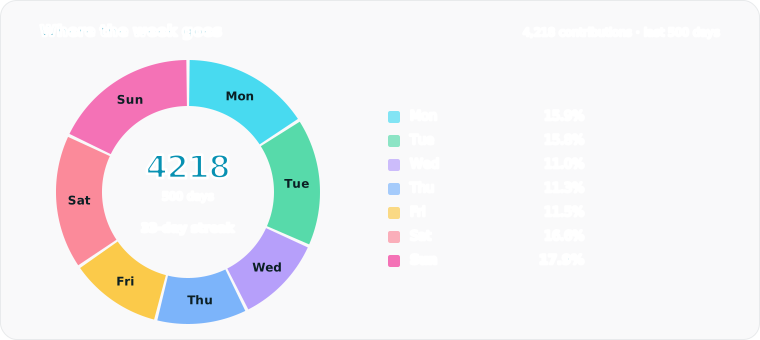
Weekday contribution share: a donut of each weekday's percentage of the last ~16 months (500 days) of contributions; the glowing slice marks the peak day.

Selected work — computational neuroscience, robotics, 3D and scientific software projects

engram: Engram builds and runs experiments with biophysical and functional neural models. An AI agent and custom harness track model sources, simulation inputs, and results. Its optional NCP controller exchanges observations and action proposals with separate applications. The tested implementation is in private Paper2Brain source. The public repository remains a placeholder pending source publication; it does not claim general paper reproduction or validated scientific results. NCP: Neuro-Cybernetic Protocol (NCP) defines typed messages for neural controllers, simulations, sensor monitors, and experiment capture. Its local v1 adapters connect Engram, CREBAIN, Galadriel, and Prisoma through private process channels. NCP is a protocol, not a central runtime or a mandatory all-project bundle. Independent adapter qualification and final release gates remain open. Haldir uses the separate pinned v0.8 interface. Languages: Rust, TypeScript, Python, C, C++.
prisoma: Prisoma develops controlled experiments for action-conditioned world models and embodied agents. Its experiment design compares candidate actions from the same saved environment state, commits forecasts before outcomes, executes the selected action, and evaluates alternatives on independent branches. It records the evidence needed to check whether forecasts improve decisions over simpler baselines. CREBAIN is its selected 3D environment; the complete adapter remains under qualification. Rerun export supports visualization. A deterministic experiment reference and NCP capture are implemented. Learned-model qualification and CREBAIN-backed forks remain open. PID is an optional diagnostic with separate validity requirements. Languages: Rust, Python. crebain: CREBAIN (Adaptive Response & Awareness System) is a standalone 3D simulation and sensor-fusion application. It combines Gaussian-splat environments, simulated camera views, drone state, and multimodal tracking. Optional NCP adapters connect neural controllers, tampering monitors, and experiment capture. CREBAIN does not require Engram, Galadriel, or Prisoma to run. The current local NCP test profile covers one through three entities; larger sensor-rich scenarios require separate scale and realism qualification. Languages: Rust, TypeScript.
melkor: Melkor provides deterministic 3D Gaussian Splatting (3DGS) conversion across PLY, SPZ and glTF. Its inspection reports surface field provenance, bounds and numeric hazards without modifying source assets. The current release candidate is source-only; no production binary is currently supported. Languages: C++, Python, JavaScript. galadriel: Galadriel is a Rust monitor for possible sensor tampering and persistent measurement anomalies. It checks prediction residuals, changes over time, and agreement between sensor modalities. An alert identifies suspicious evidence; it does not establish an attack's cause. Its NCP adapter records assessments without command authority. The current single-Visual integration test correctly reports insufficient evidence; multisensor tampering qualification and field validation remain open. Languages: Rust.
pid-rs: pid-rs is a safe-Rust library for shared-exclusions Partial Information Decomposition and mutual-information estimation: categorical SxPID, KSG MI and default-off experimental continuous shared-exclusions/PID surfaces. v0.9.0 is a GitHub-only source-review prerelease. Languages: Rust, Python. haldir: Haldir Gate researches mission authorization, signed controller intents, admission, deterministic policy, and decision receipts. Its 0.9 review remains NO_GO. It is outside the NCP local v1 simulation profile; gated requests must be rejected before endpoint preparation. Local NCP digests are not Haldir signatures. No production readiness or airworthiness is claimed. Languages: Rust.
manwe: Manwe is an alpha airspace-perception research and validation workbench spanning vision, audio, multi-camera geometry and multi-target tracking, with a Python numerical/training package and Rust/Candle inference benchmarks. It targets candidate outputs for systems such as Crebain but currently ships no drop-in Crebain adapter. Languages: Python, Rust. cortexel: Cortexel is an unreleased TypeScript library and CLI for neural-simulation figures: it validates and canonicalizes strict declarative JSON requests with fail-closed provenance, then returns deterministic SVG plus a complete exact-value table. main is 0.10.0-dev.0; v0.9.0 is the last tagged preview. Languages: TypeScript.
relief-atlas: relief-atlas is a Python generation pipeline and 10,079-item manifest and prompt catalog for disaster-relief, humanitarian-aid and civil-protection meshes. The repository currently contains 125 GLBs, not a complete 10,079-mesh corpus. Languages: Python. cobot-atlas: cobot-atlas is a Python generation pipeline for a public MIT dataset of 2,023 unique glTF 2.0 Binary meshes (2,024 GLB files, 33.5 GB) for robot/cobot simulation, manipulation research, VLA training and benchmarking. Languages: Python.

How the work relates

NCP sits at the center as a shared interface. Solid connections identify local v1 adapters; the dash-dot connection identifies Haldir's pinned v0.8 adapter. Short dashed arrows show library dependencies. A long dashed open arrow connects CREBAIN to Prisoma for environment and sensor data; that integration remains under qualification. Dotted lines show assets or exports. Moving dashes on a continuous line identify perception tools. Motion is decorative; each connection retains its meaning when still. These connections do not require every project to run together or depict a runtime broker.
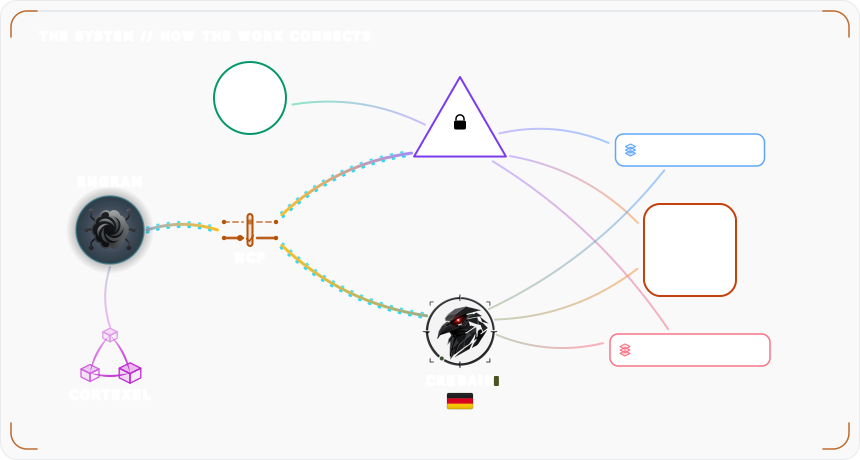
NCP at the center connects Engram, CREBAIN, Prisoma, and Galadriel through local interfaces. Haldir has a separate pinned v0.8 interface. A long dashed open arrow shows the CREBAIN-to-Prisoma environment integration under qualification. Short dashed arrows show libraries; dotted lines show assets or exports; moving dashes on a continuous line show perception tools. Projects are separate components, not a required bundle.

Open diagram · zoom and explore · Original SVG: light · dark

Read the connections: solid paired arrows = local NCP interfaces; short dashed arrows = library dependencies; long dashed open arrow = environment integration under qualification; dotted lines = assets or exports; moving dashes on a continuous line = perception tools; dash-dot line with a square end = Haldir's pinned NCP v0.8 interface.

Different jobs: Engram runs neural models. CREBAIN runs a standalone 3D environment and sensor fusion. Galadriel monitors possible sensor tampering. Prisoma organizes experiments and evidence for embodied agents. NCP defines their shared messages.

CREBAIN and Prisoma: CREBAIN is Prisoma's selected environment for embodied-agent experiments. CREBAIN owns world dynamics and sensor observations; Prisoma owns experiment design and evidence. CREBAIN runs without Prisoma. Their complete environment adapter remains under qualification.

Scene ownership: CREBAIN consumes scenes. Melkor converts splat assets; the atlas projects provide mesh assets. Prisoma records and analyzes experiments that use an environment. These asset links describe intended inputs, not a qualified import pipeline.

One integrated example: In the current integrated test, CREBAIN sends observations to Engram, which returns action proposals. Engram also sends sensor diagnostics to Galadriel and complete exchanges to Prisoma. NCP carries these messages. Independent adapter qualification remains open.

NCP local simulation v1 candidate. Installed-artifact qualification and final release gates remain open.

Engram coordinates one local experiment and privately owns neural state. CREBAIN owns body and fusion state. Prisoma captures exact step pairs. Galadriel records actual detector output with explicit abstention.

Each owner exchanges bounded NCP requests and exact retained results through its own private process pipes. NCP is the shared contract, not another simulation engine.

One Visual modality remains insufficient for Galadriel's unchanged two-modality minimum. An unavailable observation never becomes a zero residual or a nominal report.

Supported boundary: This candidate targets local Darwin simulation. Haldir gating, remote endpoints, physical actuation, and real-time guarantees are excluded. Gated requests must be rejected before endpoint preparation. Capture and monitor results grant no command authority.

The tested Engram implementation is private Paper2Brain source. The public Engram repository is a placeholder, not an executable release. Read the NCP repository and release status.

One local v1 composition: four owners and their private channels
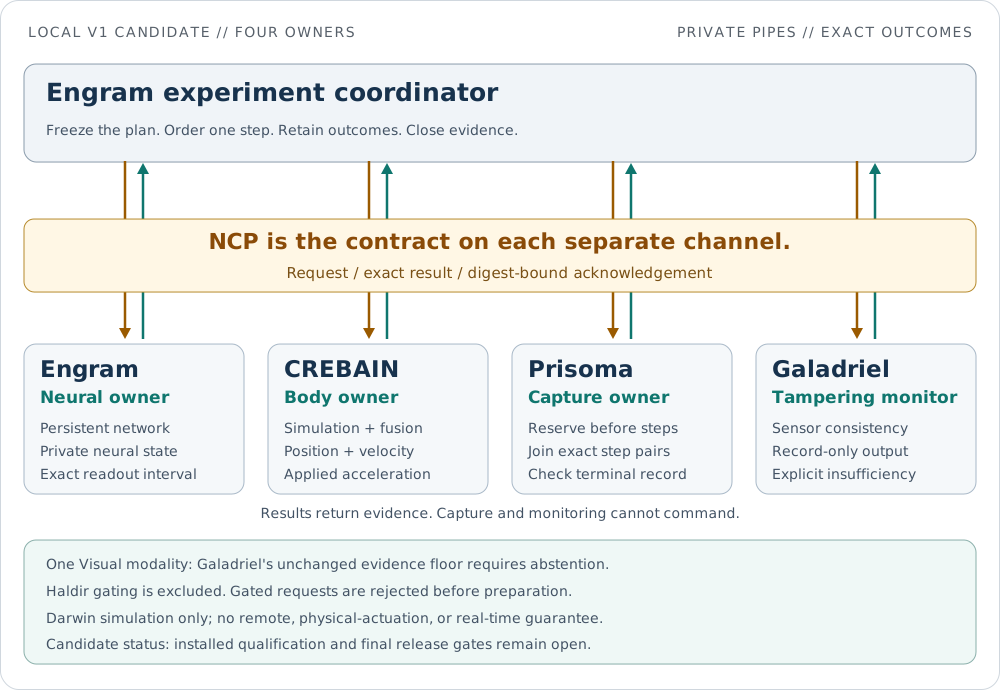
Engram coordinates one local experiment and privately owns neural state. CREBAIN owns body and fusion state. Prisoma captures exact step pairs. Galadriel records actual detector output with explicit abstention. This candidate targets local Darwin simulation. Haldir gating, remote endpoints, physical actuation, and real-time guarantees are excluded. Gated requests must be rejected before endpoint preparation. Capture and monitor results grant no command authority.

Open diagram · zoom and explore · Original SVG: light · dark

More repositories — public research code and tools


More public repositories; a detailed link list follows.

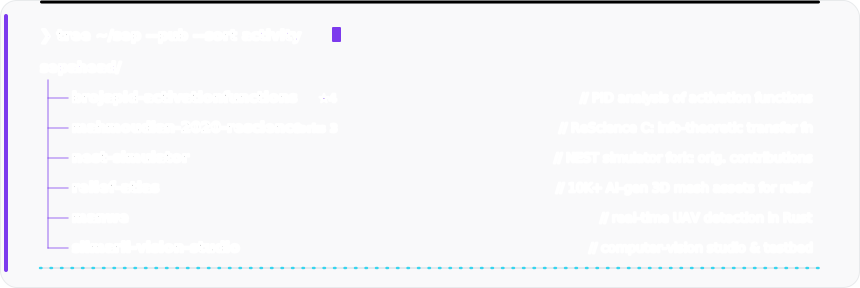
↗  brojapid-activationfunctions · mahmoudian-2020-rescience · nest-simulator · relief-atlas · silmaril-vision-studio

The toolbox — languages, frameworks and infrastructure


AI / ML stack: Python, PyTorch, NumPy, Pandas, SciPy, Pydantic, scikit-learn, Jupyter
Python    PyTorch    NumPy    Pandas    SciPy    Pydantic    scikit-learn    Jupyter
Backend & Systems stack: Rust, C, C++, FastAPI, Drizzle ORM, PostgreSQL, gRPC, Zenoh
Rust    C    C++    FastAPI    Drizzle ORM    PostgreSQL    gRPC    Zenoh
Cloud & DevOps stack: Cloudflare, Google Cloud, AWS, Docker, Kubernetes, Terraform, GitHub Actions, Linux
Cloudflare    Google Cloud    AWS    Docker    Kubernetes    Terraform    GitHub Actions    Linux
Frontend & Web stack: JavaScript, TypeScript, React, Vite, TanStack, Tailwind CSS, Vitest
JavaScript    TypeScript    React    Vite    TanStack    Tailwind CSS    Vitest

Agentic engineering — the AI-agent development stack

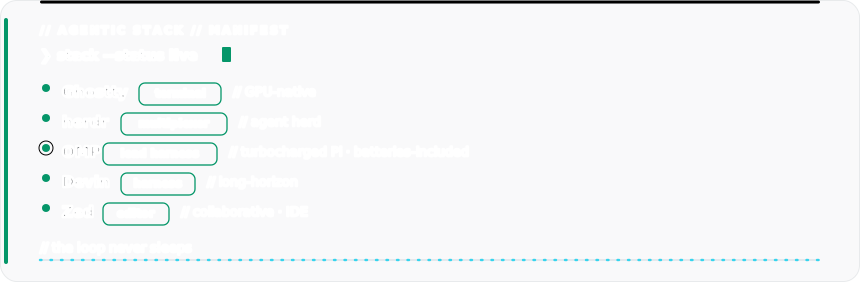
Agentic stack manifest: Ghostty (terminal, GPU-native); herdr (multiplexer, agent herd); OMP (lead harness, turbocharged Pi with batteries included); Devin (harness, long-horizon); Zed (editor, collaborative IDE).

Elsewhere — contact channels

Open channel: reach me at sepmhn@gmail.com; always open to interesting problems.

Pinned Loading

  1. crebain crebain Public

    CREBAIN (Adaptive Response & Awareness System) — research prototype for spatial awareness and sensor fusion: Gaussian-splat scene visualization, simulated cameras, ML object detection, multimodal 3…

    Rust 21

  2. engram engram Public

    Engram Neural Modeling Labs — computational-neuroscience research on spiking networks and neural modeling. Code will be open-sourced after publication.

    15

  3. NCP NCP Public

    Neuro-Cybernetic Protocol: versioned canonical-JSON contract connecting neural simulators and neuromorphic controllers to robots, UAVs and analysis clients over Zenoh. Rust reference, independent T…

    Python 16

  4. melkor melkor Public

    C++17 toolkit for 3D Gaussian splats: deterministic conversion, inspection, geometry-based scene completion and viewing across PLY, SPZ and glTF, with CPU/Metal and optional CUDA backends. v2 harde…

    C++ 13 1

  5. pid-rs pid-rs Public

    Partial Information Decomposition and mutual-information estimation in safe Rust: categorical shared-exclusions PID (SxPID), KSG MI estimators and default-off experimental continuous PID surfaces. …

    Python 15

  6. cobot-atlas cobot-atlas Public

    Python generation pipeline behind a public MIT dataset of 2,023 unique glTF 2.0 Binary meshes (33.5 GB) for robot/cobot simulation, manipulation research and VLA training. Published on Hugging Face…

    Python 7